

We weren’t supposed to have the Jeep. When planning and budgeting the trip months earlier, we hadn’t even considered it.
“I don’t care what we drive,” I replied when Lee asked what kind of rental car I wanted. “As long as it gets us where we wanna go, it’s fine.”
If I’d thought to look up from whatever I was working on at the time, I’d have probably seen him raising a dubious eyebrow at me. The last time we’d rented a car on a trip, I insisted on a smurf-blue Ford Mustang.
“We can’t tour California wine country in a Camry,” I’d probably said at the time. “It just doesn’t set the right tone for the trip.”
Whenever I rented a car for work trips (which was frequently, at one point in my career), I railed against the Chevy Aveos and Hyundai Accents that were most frequently waiting when I landed, and was over the moon whenever fortune handed me something more interesting, like a Fiat 500 or VW Tiguan, on a university-sanctioned rental budget.
“Driving is supposed to be fun,” I always maintained. “It’s all about the journey and the experience, not getting from point A to point B!”
So if Lee doubted my sincerity when I said any old car would do, or worried that maybe something was a little off with me, he had reason.
Point A to point B. There’s no time for the scenic detours when you’re running on fumes, and by the time we were counting down the weeks to Hawaii, my tank was definitely empty.
Three years of coursework, research, and writing a dissertation — on top of the usual stressors of the forty-hour-week career — had taken their toll. As professionally and personally fulfilling as the research project was that I’d been working on these long years, as much as I love my career itself, and as excited as I was for what may come next, I wanted a vacation. And though I didn’t quite grasp it yet, I needed a reset. I needed to remember the journey.
Island time runs a little differently. It seems people move more slowly, like there’s nowhere particularly important to be. Sometimes shops close at noon for lunch, and are still closed two or three hours later. If business is slow, they might shut down early. And customers are treated conversationally, not transactionally.
We’d been standing in line for nearly half an hour — while three customers were served ahead of us — and I was slightly irritable by the time we reached the rental counter.
It had been a long seven hour flight from Phoenix to Lihue, and after six months of planning, I was anxious to start our vacation. The plane landed at 2pm local time. According to my mental calendar, that meant being on a sunny beach somewhere was scheduled to commence by 2:30. That was my expectation.
Schedules. Expectations.
These are things we fall into the unfortunate habit or necessity of living by. In my haste not to forget anything I’d need when packing my suitcase the night before, I’d apparently brought these along.
We were already running behind, and I sensed my expectations in danger of being dashed. Because aside from the leisurely processing time of the rental counter agents, the weather didn’t seem to be cooperating, either.
For the past two weeks, I’d been glued to my weather app, and the Kauai seven-day forecast had become an obsession.
“It’s raining again in Hawaii,” I laughed nervously one morning over coffee, t-minus twelve days to vacation. I repeated myself a couple hours later, coming back from the gym, and still again settling into bed for the night.
“I hope it clears up by the time we get there,” I half-whined, half-prayed, several days later.
“It’s a tropical island,” Lee reasoned. “I’m sure it rains a bit every day, but it’s not going to be rainy all the time. Don’t worry. And even if it rains every day, we’ll still have fun.”
“It was sunny all last month, though,” I tried not to fume.
Yet as we winged in on our descent, the Eastern coast of Kauai was shrouded in a low, dark cloud bank.
So when we finally made it to the reservation counter and waited (im)patiently — all while listening to a group of locals taking about the road to the Na Poli coast being washed out by a storm and impassible — only to have the clerk cheerily hand over the keys to a Chevy Malibu, all my tiny disappointments culminated in a realization.
I didn’t fly three thousand miles to drive an appliance. Or to be stopped by a little rain.
Aloud, I hesitated: “Oh. Do you have something a little…sportier?”
Giving Lee a sidelong glance, I swear I saw his eyebrow arched and a smirk tugging at his mouth: see? I told you so.
The journey is almost certainly as important as the destination. Do you arrive safe and securely, cocooned from the little bumps along the way, or do you pull up wind-blown and with an exhilarated grin after taking every rutted, twisty sideroad along the way?
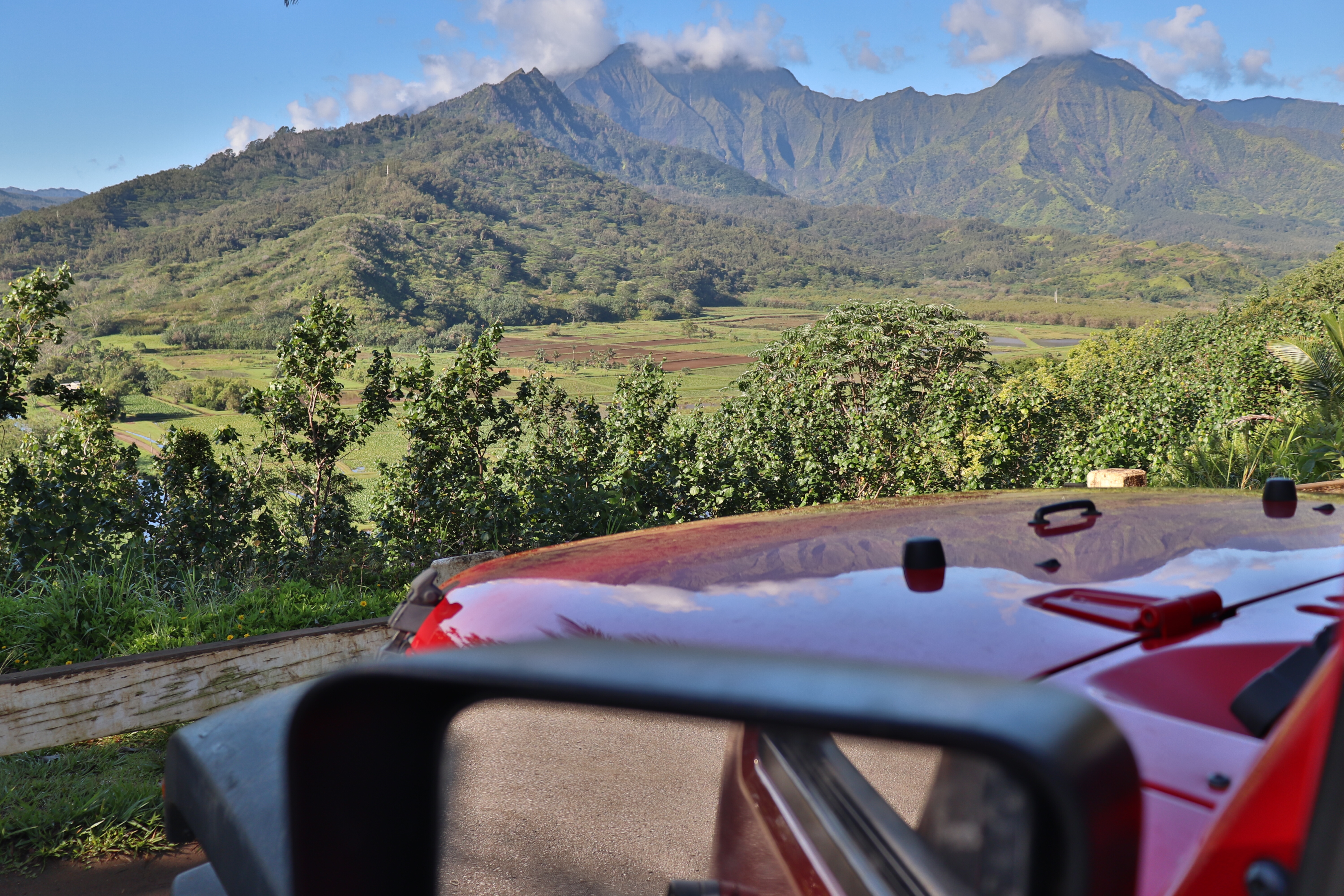
I’ve always been a car guy. Growing up road-tripping across the American West in my dad’s old rust-orange GMC pickup or my mom’s tiny blue Subaru wagon, a significant chunk of my earliest memories involve the road. The sensations of barreling through the Nevada desert or Montana prairie, windows down, face pressed out into the slipstream and the hum of tires on the highway sharing the spotlight with John Denver’s Calypso as the soundtrack to the adventure, are an indelible artifact of my childhood. The cars weren’t just the conveyance; they were part of the story, the memory, a connection to a point in time. The right ride evokes something amazing.
We were in Hawaii, damn it. We were here for adventure, an experience. A Malibu is designed for comfortably, if numbly, commuting through life on-schedule and according to plan, two things a vacation should not be. Nope…the Malibu wasn’t going to cut it.
Life — and our indelible memories that make it worthwhile — is as much about the journey as the destination.
Back in college, when I was studying abroad in Australia, a group of us rented an old Toyota Land Cruiser for a week-long camping trip on the barely-developed Fraser Island, a seventy-something mile long spit of land perched just off Australia’s eastern seaboard and the edge of it’s continental shelf a few hours’ drive north of Brisbane, the capital of Queensland.
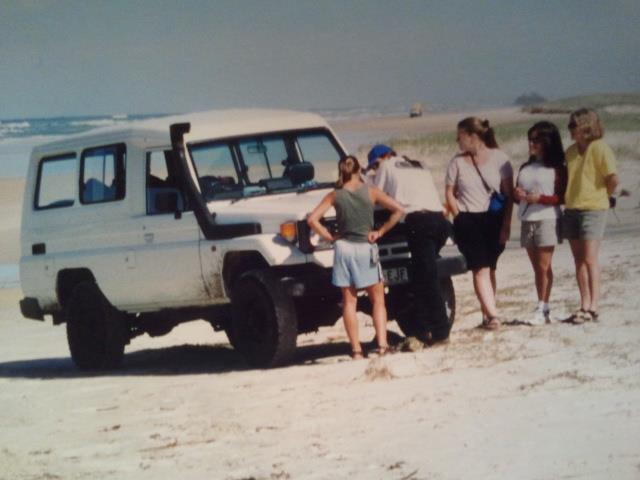
A World Heritage site, Fraser Island is a study of ecological contrasts: contained within its coastlines are tropical rainforest, old-growth hardwoods, expansive white sand beaches, behemoth drifting sand dunes, jutting basaltic cliffs, myriad lakes, and streams boasting some of the most pristine, pure water on the planet. In the course of traversing beaches, slogging across wayward dunes, and bouncing along root-strewn, muddy, rutted jungle trails, we managed to crack the Land Cruiser’s beefy rear leaf spring suspension, and I’m not sure how many times we broke down or got lost.
That was an adventure. The old beast was part of the experience, an integral part of the narrative, a character in the story.
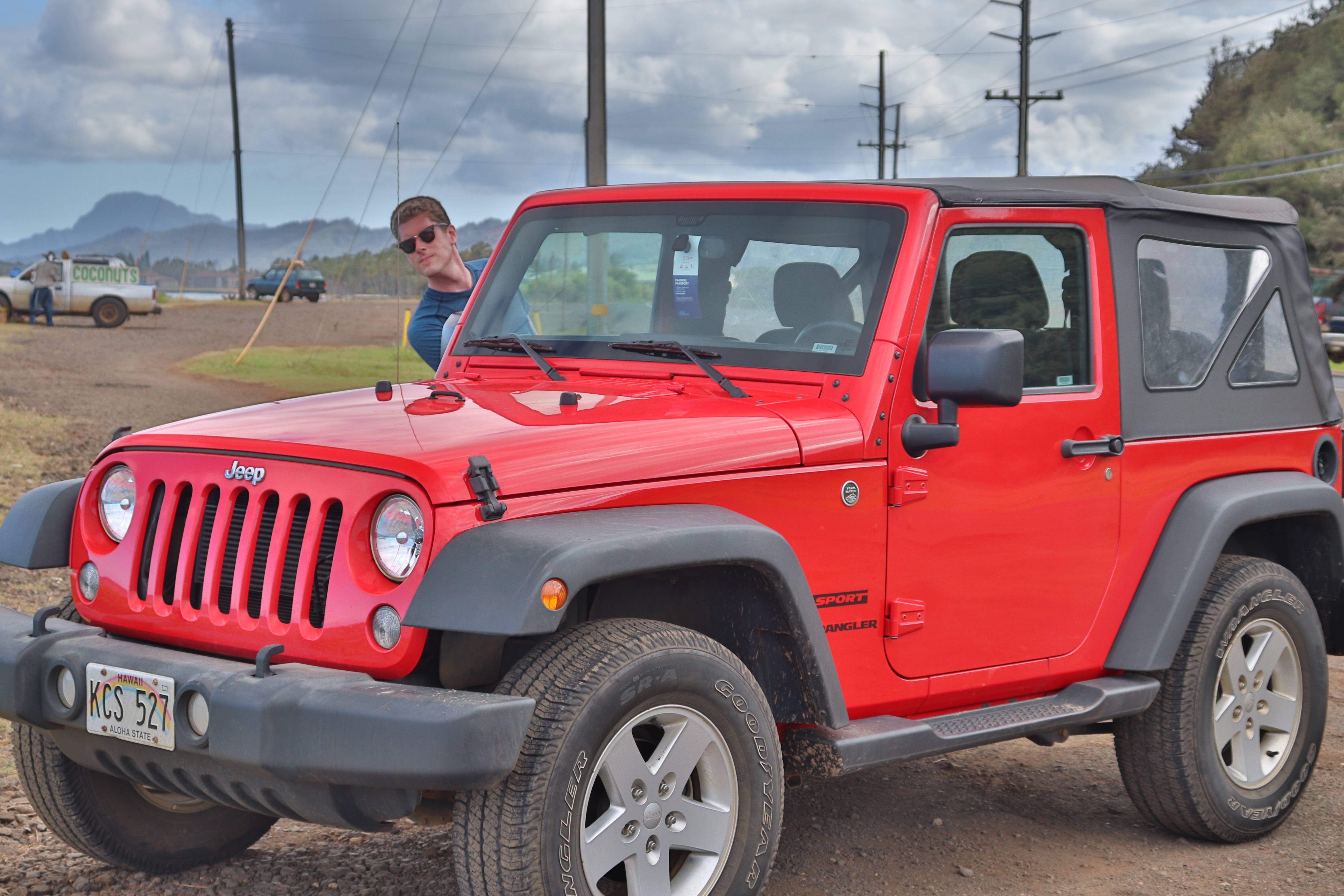
What we needed here wasn’t a conveyance, but an accomplice.
The rental agent sensed this.
“We have way too many Jeeps right now,” she paused, dangling the Chevy’s keys. “I can upgrade you?”
I think by this point, both Lee and I were smirking. In my mind, the sky outside was already a little brighter.
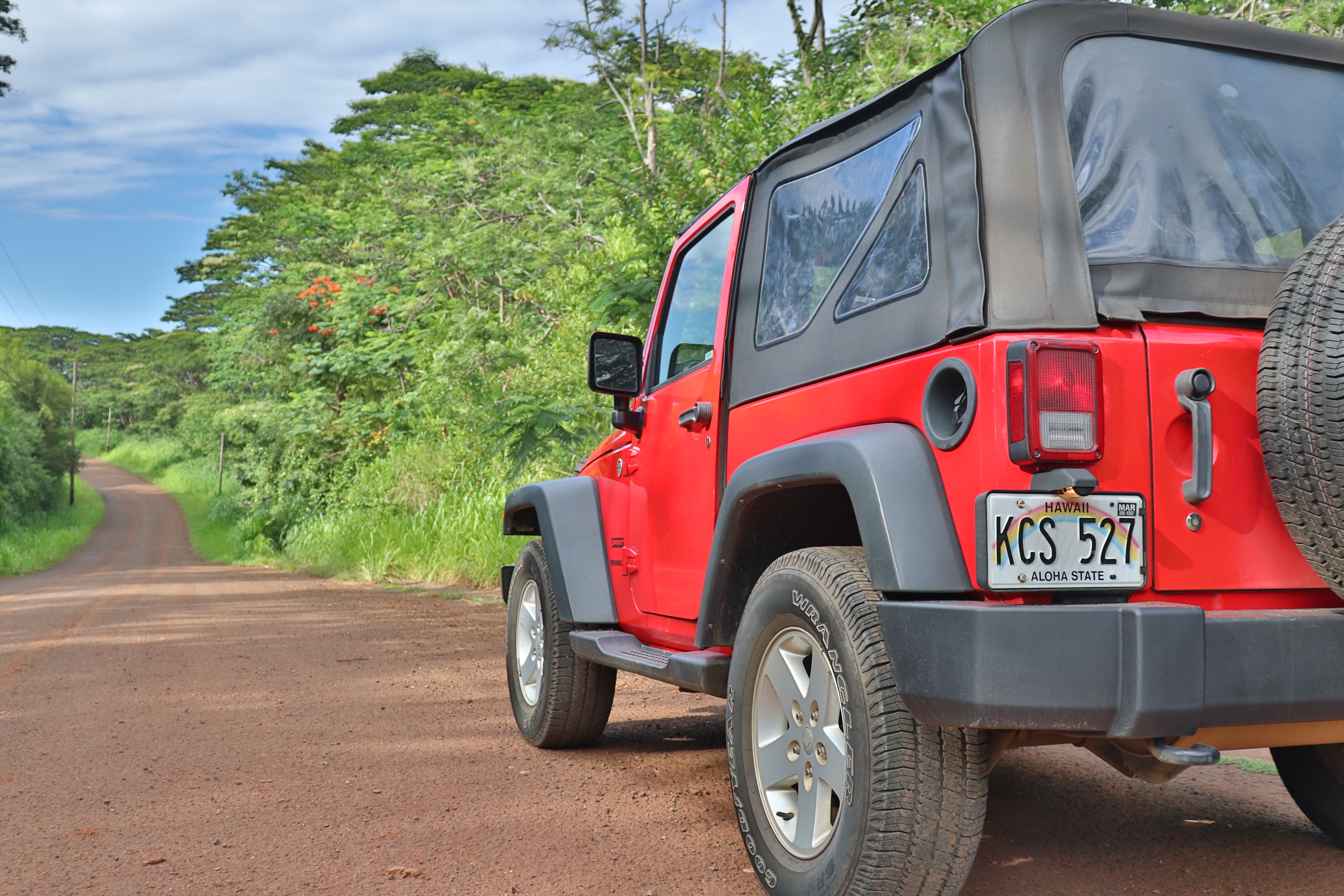
That’s how we ended up with a cherry-red Jeep Wrangler, complete with two doors and the old-school canvas top.
We ran the wheels off that thing (within reason).
And it was the much better choice. It cost significantly more — ‘upgrade’ is always car rentalese for ‘more expensive’ — but it was worth it. Looking back, I can’t imagine the experience without it.
Windows down — although the windshield and top fold down and the doors come off, we never took the time to go truly al fresco after I spent half an hour one morning tinkering with the zippers and levers on the top only to find it stuck mid-retraction — the little Jeep was our gateway to freedom.
Kauai is a small island, all things considered. Traffic in Kapa’a and Lihue willing, you can circumnavigate it from the resorts at Hanalei on the northern point of the island all the way around to remote Polihale National Park — the westmost terminus accessible only by a final five-mile stretch of unimproved dirt road — in a couple hours.
We did this two days in a row — nearly getting stuck once — just to see the evening sun sink beyond what felt like the end of the world.
Over the course of eleven days, we stopped at nearly every beach. By the end, we knew the island. It had become familiar, it’s roads like the comfortable lines of a forever-known face. We wound our way into the backcountry and past the old sugar plantations inland from Wailua to hike to waterfalls and into hidden valleys, sought out the remnants of the stone heiau temples, slogged up the red-earth grades into Waimea Canyon, crawled through traffic at Poipu, and explored myriad dirt beach accesses and the lighthouse at Kileaua. Once, we hit the road at 3am to drive across the island and hike an hour in the pitch dark to the top of NouNou Mountain — nicknamed the Sleeping Giant in reference to local mythology — to watch the sun break over the Pacific at dawn. Most nights, after returning to Princeville or Hanalei for a quick dinner, we’d drive out to yet another tiny beach to sit and just listen to the incessant surf as an impossible number of stars came out.
Every night, we crept back to our rented timeshare exhausted and sore and coated in sand, sunblock and sweat, declaring the day to be the best day ever.
Aside from the occasional drifting storm, it never rained on us for more than a few minutes.
The Jeep was our accomplice, our ticket to that freedom. It was part of that eleven-day string of best days ever.
We filled the gas tank five times.
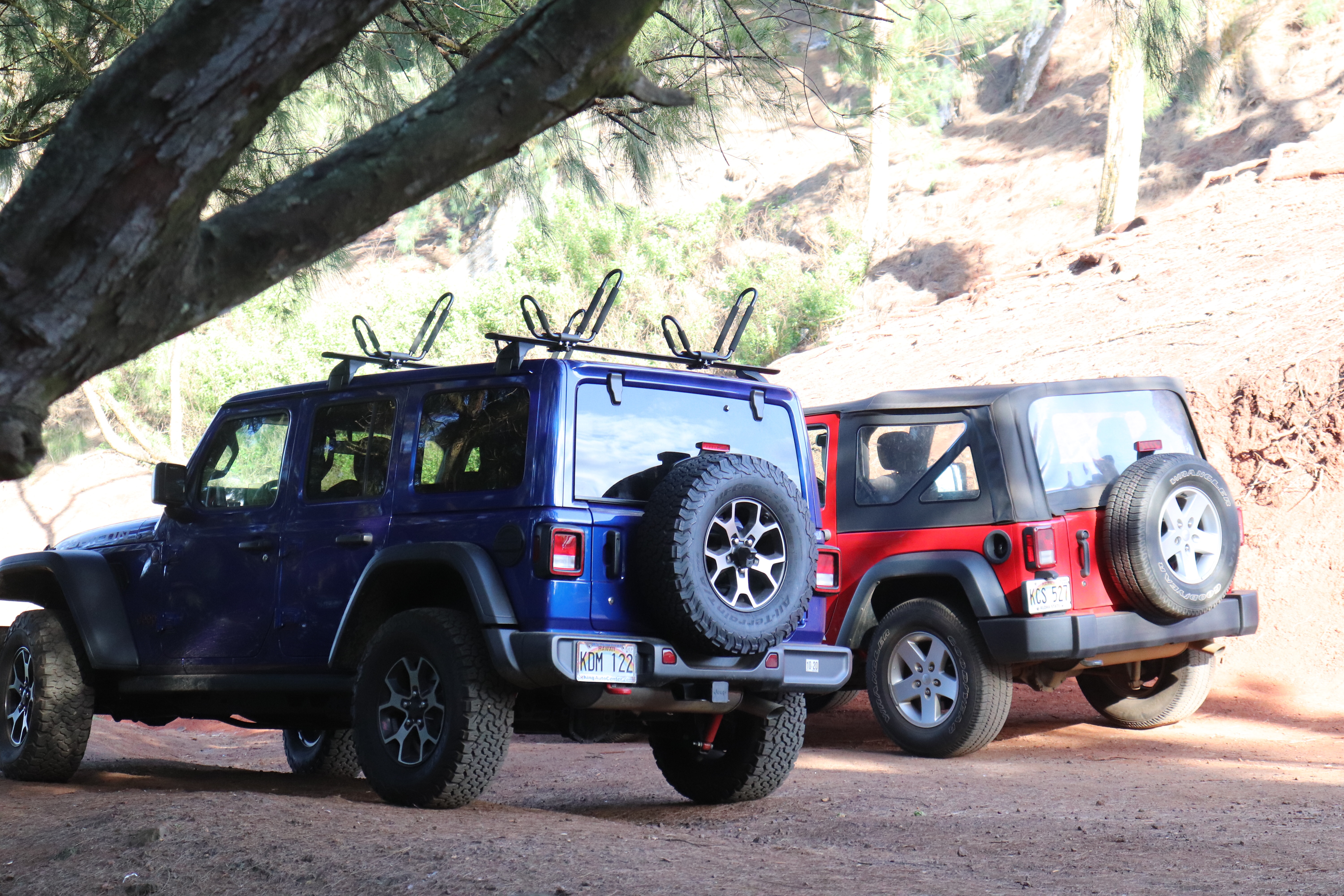
Dropping off the keys and leaving the Jeep in the rental return lot the final morning was a solemn affair — not so much because we were leaving the Jeep behind, or because we’d particularly miss it, but because we were leaving behind everything it had come to represent. Vacation was over — no more freedom to wander down any trail or sideroad on a whim and without a care for the time or a set schedule.
After clearing out the dashboard cubbies — a rock or shell tucked here, a tiny piece of driftwood there — and trying (in vain) to brush out some of the sand accumulated in the footwells, it was time to go.
Time to pack away the tangibles of the experience and consign the rest — of which the Jeep was a part — to indelible memory.
Before walking away, I patted it’s dust-coated bumper gently. It was a good little Jeep, a worthy traveling companion and a reminder to enjoy every mile of the journey.
Maybe that’s what travel does: in getting away from everything, we are purged of the urge to compromise, to numbly ride along, that the daily grind wears us down to. In traveling, we are reminded of who we are. We are forced to reset, encouraged to live to our full potential.
My daily driver for the past six years has been a tiny two-seat Mazda MX-5. It’s not tremendously practical — the suspension is on the harsh side, it’s a bit noisy, it likes to burn through its premium unleaded, and its thin canvas roof doesn’t keep out much of the summer Arizona heat — but get out of town onto a twisty mountain highway, and man, the thing is fun.
It’s been a while since I’ve flung back the top and taken the scenic route home from work or spontaneously thrown my camera in the trunk, pointed its shiny silver nose at the interstate, and headed out to aimlessly drive for the day.
Maybe it’s about time to do that again. Maybe it’s time to replace this is what I should do with this is what I’m going to do more often. Maybe red-Jeeping it is the key to holding onto who we are.
If life’s daily decisions really are as simple as taking the red Jeep over the beige Malibu, maybe I should take the Jeep more often. The mileage will be crappy and the ride will be a bit rougher, but the journey? It’ll be better.
So mahalo, little red Jeep. I hope your next occupants cram you with as many memories and life lessons as we did.

 Red Jeep Diaries
Leave a comment